
Compliance and governance: what is the difference?
The two words are often used together, but they answer different questions. Governance is how an organisation directs and controls security: who is accountable, which risks are acceptable, how decisions are made and how they are reviewed. Compliance is showing that you meet the requirements of a law, a standard or a contract, and being able to prove it to a regulator, auditor or customer.
Governance
Setting direction and holding people to it.
- Risk appetite and policy
- Roles, ownership and accountability
- Oversight and reporting to the board
- Formal risk acceptance and review
Compliance
Meeting external requirements and proving it.
- Laws such as POPIA
- Standards such as ISO 27001 and PCI DSS
- Contractual and customer requirements
- Evidence for auditors and regulators
In one sentence: governance decides how security risk is managed and who owns it; compliance proves to outsiders that it is being managed. Good governance makes compliance repeatable, and compliance evidence shows that governance works.
Why annual audits are no longer enough
Many organisations still treat compliance as an event: a scramble for evidence before the audit, a pentest report, a signed-off checklist. Then the network changes and the evidence goes out of date. The common gaps are:
- Point-in-time evidence. A report from last year says nothing about the servers, firewall rules and software added since. New vulnerabilities are published every day.
- Findings without owners. Auditors look for proof that issues were fixed on time. Without an owner and a deadline, findings roll over from one audit to the next.
- No link between findings and controls. A list of CVEs does not tell the compliance officer which ISO 27001 or PCI DSS control is at risk.
- Undocumented risk decisions. Risks that are knowingly left open are often agreed by email, with no reason, approver or review date on record.
- No view for the board. Directors are accountable for security but receive technical reports they cannot act on.
Compliance frameworks and what they require
Almost every security law and standard expects the same core capability: identify technical vulnerabilities regularly, assess the risk, fix them in time and keep evidence. VAPTOR AI maps each finding to the controls below so the same scan serves every framework you answer to.
| Framework | What it expects | How VAPTOR AI helps |
|---|---|---|
| POPIA | Section 19: appropriate, reasonable technical and organisational measures to secure personal information, identify foreseeable risks and regularly verify that safeguards work. | Continuous testing of the systems that hold personal information, with dated proof that safeguards were checked and gaps were fixed. |
| ISO/IEC 27001 | Annex A control 8.8, management of technical vulnerabilities, within a risk-based information security management system. | Scheduled discovery and assessment, risk-ranked remediation with deadlines, and records for internal audit and certification audits. |
| PCI DSS | Requirements 6 and 11: identify and address vulnerabilities, run regular internal vulnerability scans and penetration tests. | Internal scanning and exploit verification of the cardholder data environment, with rescan evidence that fixes worked. External ASV scans are still done by an approved vendor. |
| NIST CSF 2.0 | Govern, Identify, Protect, Detect, Respond and Recover, including identifying, validating and recording asset vulnerabilities. | Asset inventory, validated vulnerabilities, risk grades for the Govern function and trend reporting over time. |
| SOC 2 | Trust Services Criteria for system monitoring and the detection of new vulnerabilities and configuration changes. | Ongoing monitoring with a scan history that shows controls operated across the whole audit period, not just one day. |
| HIPAA | Security Rule risk analysis and risk management for systems that hold electronic health information. | Repeatable technical risk analysis and a documented remediation trail. |
| MITRE ATT&CK | A knowledge base of real attacker tactics and techniques, used to understand how weaknesses would be exploited. | Findings mapped to attacker techniques so teams see the real-world impact behind each control gap. |
| ETSI EN 304 223 | Baseline cyber security requirements for AI models and systems. | Findings mapped to the standard alongside the other frameworks, for organisations bringing AI systems into scope. |
An honest note: no tool makes an organisation compliant on its own. Compliance also depends on policies, training and processes. VAPTOR AI covers the technical vulnerability management controls these frameworks share, and the evidence that they operate continuously.
POPIA and South African governance
For South African organisations, the Protection of Personal Information Act (POPIA) makes security a legal duty, not a best practice. A responsible party must secure the personal information it holds, identify reasonably foreseeable risks, maintain safeguards against them and regularly verify that those safeguards are effective. If there is a security compromise, the Information Regulator and affected people must be notified.
Corporate governance codes for South African companies place technology and information governance with the board. Directors are expected to oversee information risk, not delegate it entirely to IT. That oversight needs information a board can act on: a clear grade, a trend and confirmation that serious issues are being closed.
- Regular verification of safeguards: scheduled scans give dated proof that security measures were tested, as POPIA expects.
- Board-level reporting: an A to F security grade with a 0–100 risk score and executive summaries in plain language.
- Data minimisation: detailed results stay on-premise on the VAPTOR Watchdog by default.
How VAPTOR AI supports continuous compliance
The VAPTOR Watchdog appliance sits on your network and turns compliance from a yearly project into a routine. Each run produces the same structured evidence, so you are audit-ready on any day of the year.
Always-on assurance
Scheduled scans run daily, weekly or monthly, so new exposures are caught between audits rather than at the next one.
Validated findings
Every device and all 65,535 ports are assessed, and exploitable weaknesses are safely verified, cutting false positives from your evidence.
Control mapping
AI enriches each finding and maps it to the relevant framework controls, so compliance teams see which requirements are at risk.
Risk-based deadlines
Critical findings are due within 3 days, high within 30, medium within 90 and low within 180, adjustable to your own policy.
Verified remediation
The next scan confirms each fix and closes it, or reopens it if the vulnerability is still there.
Evidence on demand
Reports, certificates and remediation history are generated automatically, ready for auditors, insurers and customers.
Audit-ready compliance evidence
Auditors want to see that controls operated over time, not just that they exist. VAPTOR AI builds that record automatically with every scan.
- Executive reports with the security grade, risk score, vulnerability counts and compliance status.
- Technical reports with evidence and recommended fixes for every finding.
- Framework mappings linking findings to the controls they affect.
- Compliance Certificates: dated, tamper-evident certificates with the risk grade, scope and findings summary, valid for 30 days so they always reflect a recent assessment.
- Scan history and PCAP archives that show what was tested, and when.


Through the Certificate Portal, organisations and their managed service providers can view and download certificates and reports whenever an auditor, insurer or customer asks, without waiting for a consultant.
Because every certificate is dated and tied to a specific device and scan, it shows exactly what was tested and when.
Security governance and accountability
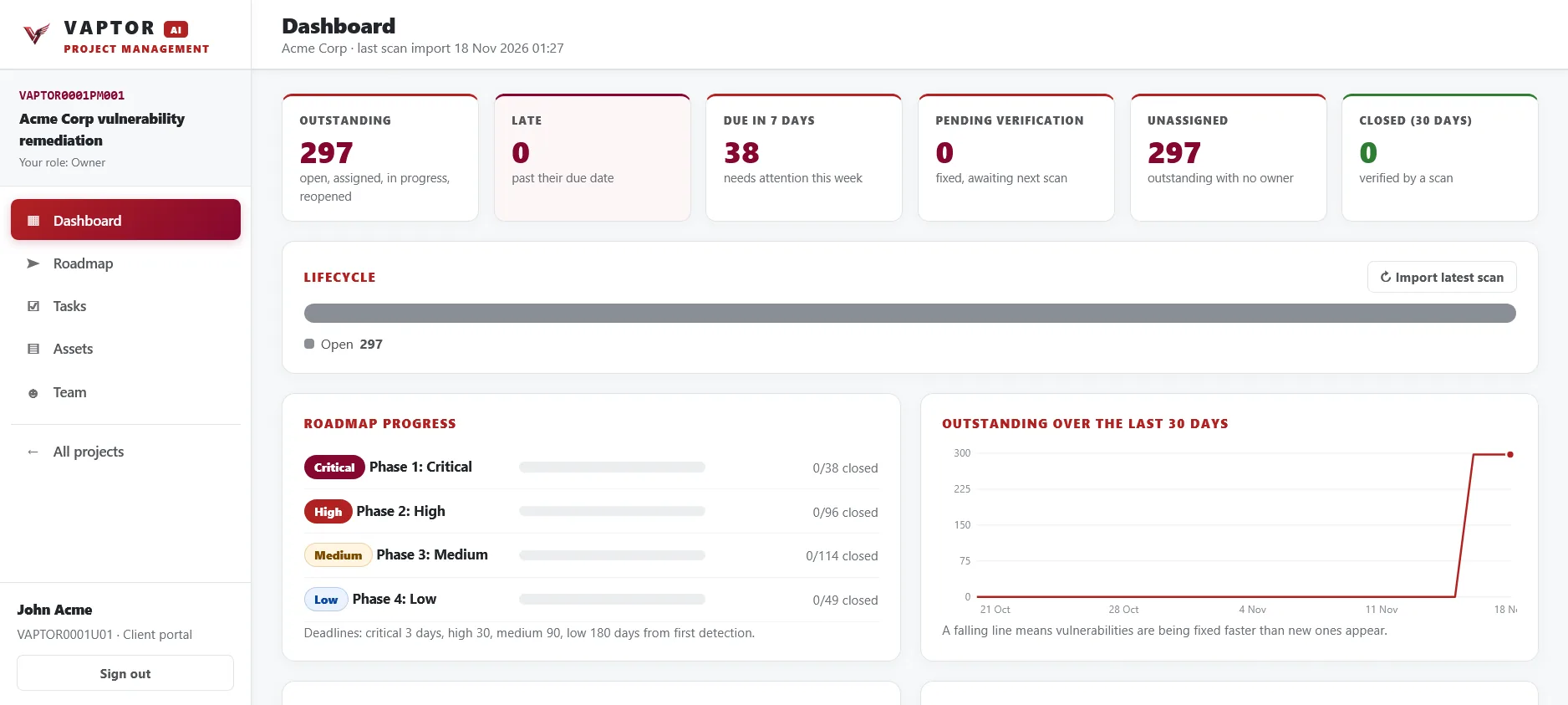
Governance is about accountability. VAPTOR AI Project Management turns each scan into a remediation plan in which every decision has a name and a date against it.
- Clear ownership: every vulnerability becomes a task with an asset owner, a task owner and a deadline.
- Formal risk acceptance: accepted risks need a written reason and a review date, are kept in a register and reopen automatically if still present after review.
- Audit trail: every status change and assignment is recorded.
- Oversight reporting: printable status reports, overdue items and a 30-day burn-down for management.
For more on the remediation lifecycle, see Vulnerability Management.
Governing the tool itself
A system that probes your network must be governed more strictly than the systems it tests. VAPTOR AI is built so that auditors can trust it, too.
- Role-based access control on the appliance (Admin, Operator, Analyst, Client) and in Project Management (Owner, Manager, Technician, Viewer).
- Two-factor sign-in for the cloud project management suite.
- No plaintext credentials: passwords are salted and hashed, and observed credentials are masked.
- Encrypted, logged integrations with sensitive fields redacted automatically.

Data protection by design
Compliance tools should not create new privacy risk. The VAPTOR Watchdog runs on your network and keeps detailed scan results there. By default only severity counts are shared with the client portal. Finding details are sent to the Project Management suite only when your organisation switches it on, so you decide where your vulnerability data lives.
Compliance and governance FAQ
What is the difference between compliance and governance?
Governance is how an organisation directs and controls security: who is accountable, which risks are acceptable and how decisions are made and reviewed. Compliance is showing that you meet the requirements of a law, standard or contract. Good governance makes compliance repeatable; compliance evidence shows that governance works.
Which compliance frameworks does VAPTOR AI support?
VAPTOR AI maps findings to POPIA, ISO 27001, PCI DSS, NIST CSF, SOC 2, HIPAA, MITRE ATT&CK and ETSI EN 304 223, so each vulnerability can be traced to the controls it affects.
Does VAPTOR AI make us compliant?
No tool can make an organisation compliant on its own; compliance also depends on policies, people and processes. VAPTOR AI covers the technical vulnerability management controls that most frameworks require and produces the evidence that those controls operate continuously.
What evidence does VAPTOR AI give auditors?
Dated scan history, executive and technical reports, framework mappings, a compliance certificate per device, remediation timelines with owners, a risk-acceptance register and an audit trail of changes.
How does VAPTOR AI support security governance?
It gives boards and managers an A to F security grade and trend, assigns every vulnerability an owner and a risk-based deadline, enforces role-based access with two-factor sign-in, records risk acceptance with a reason and review date, and keeps an audit trail of every change.
Does our compliance data leave our network?
By default the VAPTOR Watchdog keeps detailed scan results on-premise and shares only severity counts with the client portal. Finding details go to the cloud project management suite only if your organisation switches it on, which supports POPIA data-minimisation principles.