
What is exploit verification intelligence?
Exploit verification intelligence brings together two disciplines. Exploit intelligence answers the question "can this vulnerability be used?" by tracking which weaknesses have public exploit code, ready-made attack modules or confirmed exploitation in the wild. Exploit verification answers "is it really here?" by safely testing the weakness on your own systems instead of trusting a version number.
On their own, each gives half the picture. Intelligence without verification flags vulnerabilities you may not actually have. Verification without intelligence cannot tell you which confirmed issues attackers are targeting right now. Combined, they separate real, usable risk from noise.
In one sentence: exploit verification intelligence shows which of your vulnerabilities are real, reachable and actively weaponised, so the ones an attacker would use first are the ones you fix first.
Why severity scores alone mislead
Most vulnerability programmes sort findings by CVSS severity. CVSS describes how bad a vulnerability could be, not whether anyone can exploit it on your network. That gap causes predictable problems:
- False positives. Version-based detection flags software that has been patched or configured safely, so teams waste time on issues that are not there.
- Alert fatigue. Hundreds of "critical" and "high" results with no further context make everything look urgent, so nothing is.
- Missed real threats. A medium-severity flaw with a public exploit, reachable from your network, can be more dangerous than a critical one that is not.
- Attackers move fast. Exploitation of vulnerabilities is now a leading way into organisations: the Verizon 2025 Data Breach Investigations Report found it grew 34% year on year as a breach entry point.
Exploit intelligence sources
The VAPTOR Watchdog keeps a local intelligence store up to date from authoritative public sources and cross-references every finding against it.
| Source | What it tells you | How VAPTOR AI uses it |
|---|---|---|
| CISA KEV | The Known Exploited Vulnerabilities catalog: vulnerabilities confirmed as exploited in the wild. | Imported on every intelligence update, always on, as a safety net that flags high-risk items even when their CVSS score looks modest. |
| NVD (NIST) | CVE records with CVSS scores and affected products. | Severity, scoring and product matching for each finding. |
| GitHub Advisories | Vulnerabilities in software packages and dependencies. | Extends coverage to application components and libraries. |
| ExploitDB | Public exploit code availability and references. | Flags vulnerabilities for which working exploits are publicly available. |
| Metasploit | Ready-made, maintained attack and scanner modules. | Shows which weaknesses are weaponised, and supplies the safe auxiliary checks used for verification. |
| MITRE ATT&CK | Real-world adversary tactics and techniques (Enterprise, Mobile and ICS). | Maps findings to the techniques attackers would use against them. |
AI then synthesises the intelligence into plain-language narratives with prioritised remediation guidance for both technical teams and management.
How VAPTOR AI verifies exploitability
Exploit verification is one phase of the autonomous VAPTOR pipeline, running on the Watchdog appliance inside your network on the schedule you choose.
Discover
Finds every device and service across all 65,535 ports and fingerprints operating systems and software versions.
Correlate
Matches services and versions to CVEs, then checks each against KEV, ExploitDB and Metasploit for known exploits.
Probe
Confirms each target is up and responsive before any verification module runs, and skips modules that do not apply.
Verify safely
Runs targeted, non-destructive Metasploit auxiliary checks against the specific service to confirm the weakness.
Test web apps
OWASP ZAP and SQLMap confirm web vulnerabilities such as SQL injection and cross-site scripting.
Score confidence
Every finding carries a confidence score; verified results rank highest, so you know which ones to trust.
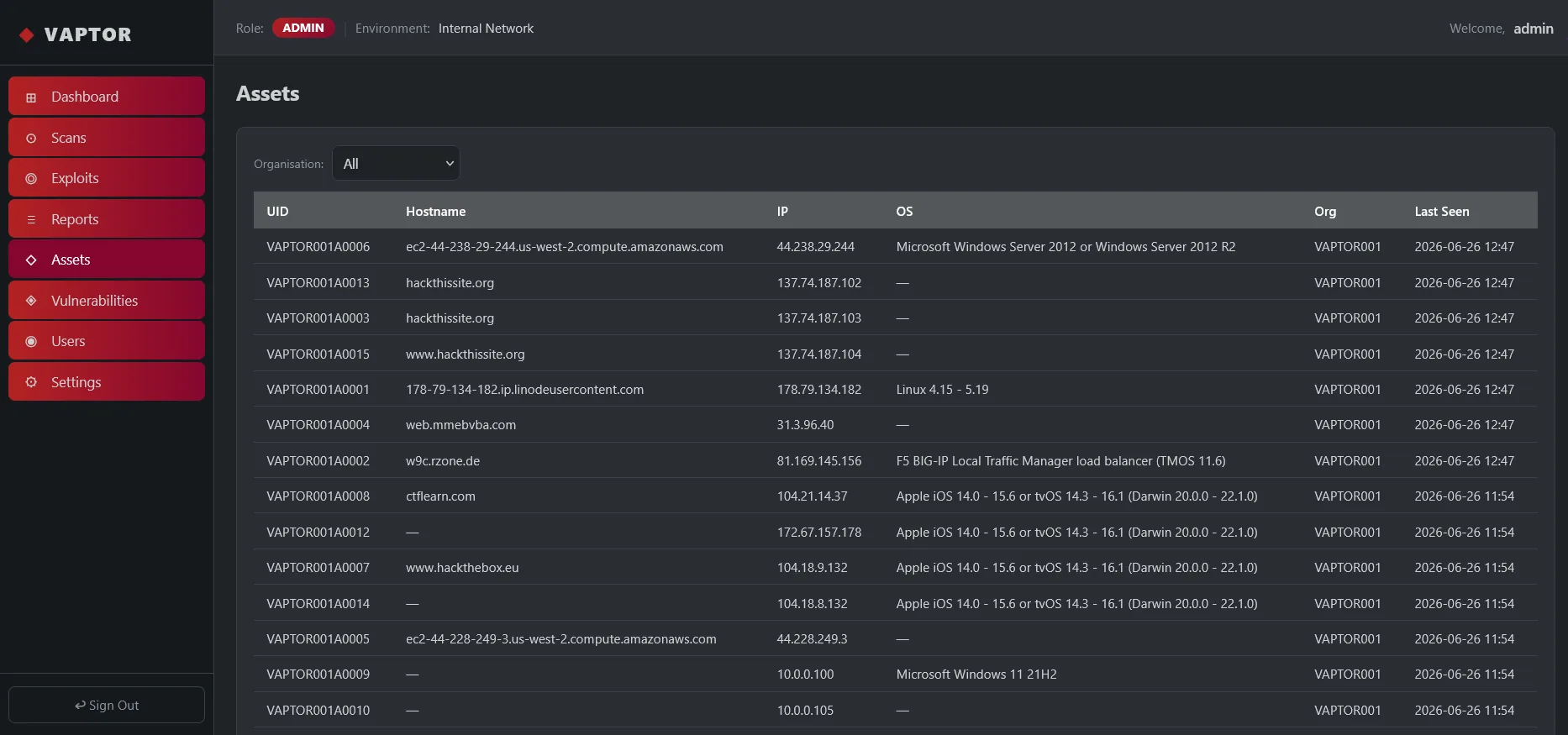
It starts with an accurate inventory
Exploit intelligence is only as good as what it is matched against. VAPTOR AI keeps a live asset inventory with operating systems and services for every device it finds, so each exploit match points to a real system with an owner.
End-of-life operating systems are flagged automatically, because they no longer receive the patches that close known exploits.
Safe by design
Verification has to prove a weakness without causing the damage an attacker would. VAPTOR AI is built so it can run on production networks, on a schedule, without someone watching.
- Non-destructive checks only: verification uses Metasploit auxiliary scanner modules; no exploit payloads are executed.
- No password guessing by default: login and brute-force modules are excluded from automatic verification.
- Opt-in credential checks: credential validation runs only when explicitly enabled, and still executes no exploits or payloads.
- Time-boxed: every module runs with its own timeout, so a slow service cannot stall the scan.
- Governed access: role-based access control decides exactly who can launch scans or run exploit checks.
- Hidden credentials: any credentials observed on the network are masked and hashed, never stored in raw form.
From intelligence to priority
Each signal changes what a finding means for your team. VAPTOR AI combines them so that the top of the list is the work that removes the most real risk.
| Signal | What it means | What to do |
|---|---|---|
| Verified on your network | The weakness was confirmed on the live service, not inferred from a version number. | Treat as real. Fix within the severity deadline. |
| Listed in CISA KEV | Attackers are exploiting it in the wild today. | Move to the front of the queue. |
| Public exploit available | Working exploit code or a ready-made module exists, so little skill is needed. | Raise priority above findings with no known exploit. |
| Theoretical only | Present by version or configuration, with no known exploit and not verified. | Schedule by severity in normal maintenance. |
Prioritised findings flow straight into a remediation roadmap with owners and risk-based deadlines, and the next scan verifies each fix. See Vulnerability Management.
Mapped to attacker techniques
VAPTOR AI maps findings to the MITRE ATT&CK framework, the industry's shared language for how real adversaries operate. Instead of a list of CVE numbers, defenders see which techniques an attacker could use against them, such as initial access through an exposed service or credential access through a weak protocol, along with a coverage summary across techniques.
This threat context helps security teams explain risk to management in terms of attacker behaviour, and helps them choose defensive controls that close whole classes of technique rather than single vulnerabilities.
Evidence you can act on

Verification produces evidence, not opinions. Each verified finding is recorded with what was tested, when and how, so technicians can reproduce it and managers can trust it.
- Verification artifacts stored with each scan, plus PCAP archives of the traffic.
- CVE cross-references with CVSS scores and exploit availability.
- AI-generated remediation steps for every finding.
- Executive reports with an A to F security grade and 0–100 risk score.
The same evidence supports audits; see Compliance & Governance.
Intelligence on-premise
Exploit intelligence and verification both run on the VAPTOR Watchdog inside your network. The intelligence store holds structured metadata only, not exploit code or full advisory text, which cuts it from roughly 3.5 GB to about 29 MB. Detailed scan results stay on the appliance; by default only severity counts are shared with the client portal.
Exploit verification FAQ
What is exploit verification intelligence?
It combines two things: exploit intelligence, which tells you whether a vulnerability has a public exploit or is being exploited in the wild, and exploit verification, which safely confirms that the weakness is really present and reachable on your network. Together they show which findings are real, usable risks.
How is exploit verification different from a vulnerability scan?
A vulnerability scan reports what might be vulnerable, often from software versions alone. Exploit verification goes a step further and confirms the weakness with a targeted, controlled check, which removes many false positives and gives evidence you can act on.
Is exploit verification safe to run on production networks?
VAPTOR AI verifies with non-destructive checks only. It uses Metasploit auxiliary scanner modules, skips login and brute-force modules by default, never executes exploit payloads, applies per-module timeouts and checks that a target is responsive first. Credential validation runs only when it is explicitly enabled.
Where does VAPTOR AI's exploit intelligence come from?
From the CISA Known Exploited Vulnerabilities catalog, the NIST National Vulnerability Database, GitHub Security Advisories, ExploitDB, the Metasploit module index and MITRE ATT&CK. The appliance keeps these feeds up to date on-premise.
Does VAPTOR AI store exploit code?
No. VAPTOR AI stores structured metadata only, such as CVE references, exploit availability and module names, not exploit code or full advisory text. This keeps the intelligence store small, at roughly 29 MB instead of several gigabytes.
Why prioritise by exploitability instead of CVSS score alone?
CVSS measures how severe a vulnerability could be, not whether anyone can or does exploit it. A medium-severity flaw with a public exploit that is reachable on your network can be more urgent than a critical one that is not. Exploit intelligence and verification put the real risks first.