What is vulnerability management?
Vulnerability management is the continuous process of identifying security weaknesses in your systems, prioritising them by real-world risk, assigning and remediating them, and verifying that each fix worked. Done well, it shrinks your attack surface week after week instead of producing a report that sits in an inbox.
It is often confused with two related activities. A vulnerability scan is a single automated check that lists known weaknesses. A penetration test is a point-in-time attempt to break in. Vulnerability management is the programme around both: it runs scans on a schedule, decides what matters most, makes someone accountable for each fix and tracks it until it is closed.
Vulnerability management is in turn one input to cyber risk management: the business process that decides which risks the organisation reduces, accepts, transfers or avoids.
In one sentence: vulnerability management is a loop of discover → prioritise → remediate → verify, repeated continuously, with clear ownership and deadlines at every step.
Why vulnerability management programmes stall
Most organisations do not lack vulnerability data; they drown in it. The same issues come up again and again:
- Point-in-time testing. An annual pentest describes one day. New vulnerabilities are published daily, so the gap between tests is the window attackers use.
- Too many findings, no priorities. Hundreds of results without a clear order mean teams fix what is easy rather than what is dangerous.
- No ownership. When a finding belongs to "IT", it belongs to nobody. Without an owner and a due date, nothing moves.
- No proof of the fix. A ticket marked "done" is not the same as a vulnerability that is gone. Without re-testing, issues quietly return.
- No view for management. Leaders need a grade and a trend, not a 300-page technical report.
The VAPTOR AI vulnerability management lifecycle
The VAPTOR Watchdog appliance sits on your network and runs the whole lifecycle autonomously, on the schedule you choose. Each stage feeds the next, so nothing falls between the cracks.
Discover
Finds every device and service on the network, from servers and endpoints to printers and IoT, and builds an up-to-date asset inventory.
Assess & verify
Scans all 65,535 ports, identifies vulnerabilities and safely verifies which are actually exploitable, cutting false positives.
Prioritise
Grades overall risk from A to F and ranks every finding by severity, exploitability and the asset it affects.
Assign
Turns each vulnerability into a task with an owner, a phase and a deadline in a remediation roadmap.
Remediate
Gives technicians the asset, evidence and recommended fix; they update status and add notes as they work.
Verify & report
The next scan confirms each fix and closes the task automatically, or reopens it. Reports show progress to management and auditors.
See your risk at a glance
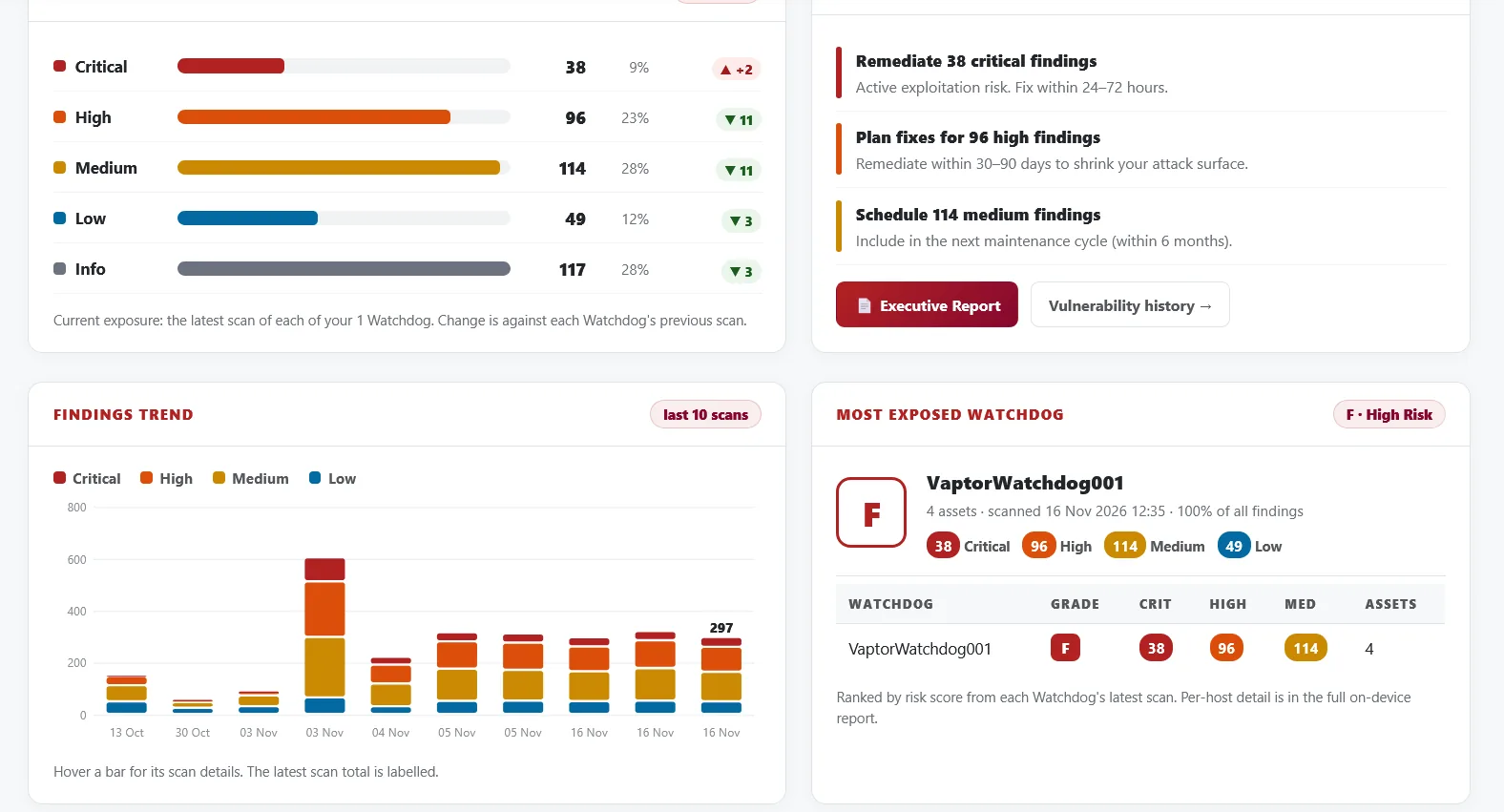
The Security Overview in the VAPTOR client portal answers the questions leadership actually asks: how exposed are we, is it getting better, and what should we do first?
- Security grade from A to F with a 0–100 risk score, the same grade as the executive report.
- Vulnerability breakdown by severity with the change since the previous scan, so you can see remediation working.
- Priority actions in plain language, with recommended timeframes.
- Findings trend across recent scans and the most exposed Watchdog site.
From findings to a remediation roadmap
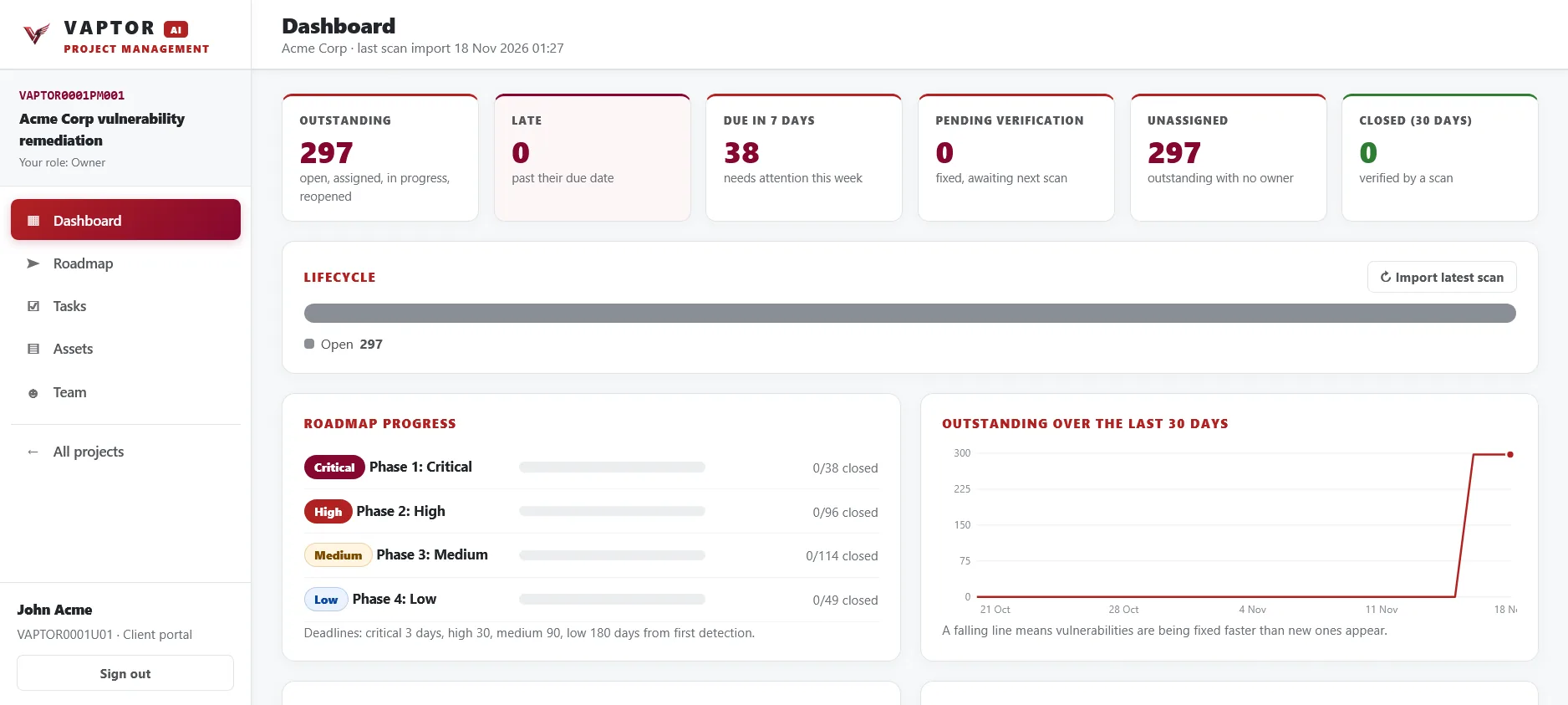
VAPTOR AI Project Management converts the latest scan into a remediation project, so technical teams and management work from the same plan.
- Four-phase roadmap: every vulnerability on every asset becomes a task, grouped critical, high, medium and low.
- Owners and roles: assign asset owners and task owners, with Owner, Manager, Technician and Viewer access.
- Lifecycle tracking: open, assigned, in progress, fixed, verified, reopened, risk accepted.
- Automatic verification: each new scan closes fixed items and reopens anything that returns.
- Audit trail and reports: every change is recorded, with a printable status report and a risk-acceptance register.
Risk-based prioritisation and deadlines
Effective vulnerability management fixes the most dangerous issues first. VAPTOR AI sets a deadline for every finding from the day it was first detected, based on its severity. Organisations can adjust these windows to match their own security policy.
| Severity | Roadmap phase | Fix within | Why |
|---|---|---|---|
| Critical | Phase 1 | 3 days | Actively exploitable; the highest chance of a breach. |
| High | Phase 2 | 30 days | Serious weaknesses that significantly widen the attack surface. |
| Medium | Phase 3 | 90 days | Schedule into regular maintenance cycles. |
| Low | Phase 4 | 180 days | Hardening and hygiene improvements. |
When a risk cannot be fixed in time, it can be formally accepted with a written reason and a review date. Accepted risks are listed in a register and reopen automatically if they are still present after the review date.
Vulnerability management metrics that matter
A vulnerability management programme is only as good as its results. VAPTOR AI tracks the metrics that show whether your exposure is actually shrinking:
- Outstanding vs closed vulnerabilities, overall and per roadmap phase.
- Overdue tasks past their deadline, and tasks due in the next seven days.
- Pending verification: fixes awaiting confirmation by the next scan.
- Burn-down: outstanding vulnerabilities over the last 30 days; a falling line means you are fixing faster than new issues appear.
- Workload and exposure by owner and by asset, to spot bottlenecks and the riskiest systems.
Compliance and audit evidence
Most security standards require a working vulnerability management process: regular scanning, timely remediation and evidence that it happens. VAPTOR AI maps findings to the controls of major frameworks and keeps the records auditors ask for, including scan history, remediation timelines, owners, and accepted-risk approvals.
Your data stays on-premise
The VAPTOR Watchdog runs on your network and keeps detailed scan results there. By default only severity counts are shared with the client portal for the Security Overview. Finding details are sent to the Project Management suite only when your organisation chooses to switch it on, so you stay in control of where your vulnerability data lives.
Vulnerability management FAQ
What is vulnerability management?
Vulnerability management is the continuous process of finding security weaknesses in your systems, prioritising them by risk, assigning and fixing them, and verifying the fixes. It is a cycle, not a one-off scan.
How is vulnerability management different from a penetration test?
A penetration test is a point-in-time assessment of how an attacker could get in. Vulnerability management is the ongoing programme that finds weaknesses on a schedule and tracks each one until it is fixed. VAPTOR AI combines both: autonomous testing with exploit verification, and remediation tracking.
How often should we scan for vulnerabilities?
At least monthly, and weekly for internet-facing or high-change environments. New vulnerabilities are published every day, so the gap between scans is the window attackers use.
How quickly should vulnerabilities be fixed?
VAPTOR AI uses risk-based deadlines from first detection: critical within 3 days, high within 30 days, medium within 90 days and low within 180 days. Organisations can adjust these to their own policy.
How do you know a vulnerability is really fixed?
With VAPTOR AI a task marked fixed waits for the next scan. If the scan no longer finds the vulnerability, the task is closed as verified; if it is still there, the task is reopened automatically.
Does vulnerability data leave our network?
By default the VAPTOR Watchdog keeps scan detail on-premise and shares only severity counts with the client portal. Finding details are sent to the cloud project management suite only if your organisation switches it on.